
If your ideal feline companion is an independent, aloof pet that sits passively on a cold windowsill and blends quietly into the background, the Sphynx is definitively not the match for you. Universally celebrated as the absolute clown and most striking exhibitionist of the domestic cat world, this breathtaking breed is famous for its hairless silhouette, its oversized bat-wing ears, and an extraordinary, high-octane personality that makes them behave like a cross between a monkey, a dog, and a loving child.
Often described as a living hot-water bottle wrapped in soft suede, the Sphynx lives life at full throttle. They are intensely human-oriented, exceptionally bright, and highly active companions that treat their owners as personal heating elements to embrace. Let’s dive deep into the Canadian history, specialized epidermal mechanics, and vibrant behavioural profile of the extraordinary Sphynx cat.
🐾Physiological and Behavioral Profile
| Breed Attribute | Standard Metric / Trait |
|---|---|
| Average Weight | Males: 3.6kg – 5.4kg (8–12 lbs) Females: 2.7kg – 3.6kg (6–8 lbs) |
| Average Lifespan | 12 to 15 years |
| Coat Texture & Type | Hairless look; skin covered in fine, peach-fuzz down; textures range from chamois to suede |
| Energy & Activity Level | Extremely High (Highly acrobatic, perpetually active, craves cognitive engagement) |
| Vocalization Level | Moderate to High (Highly communicative; uses unique trills, chirps, and demanding meows) |
A Toronto Winter Miracle: The Origin of the Hairless Mutation
Contrary to popular myths linking them to ancient Egyptian pharaohs, the modern pedigreed Sphynx is a proud product of Canadian breeding programs. The breed’s lineage can be traced back to a single spontaneous genetic mutation discovered in 1966 in Toronto, Ontario, Canada.
A standard black-and-white domestic shorthair queen gave birth to a litter that included a single, completely hairless male kitten. The owner named the kitten Prune, and breeders quickly stepped in to analyze this striking physical anomaly.
Geneticists discovered that the hairless trait was driven by a recessive gene mutation (classified as the KRT71 gene variant). This meant a kitten had to inherit a copy of the mutated gene from both parents to look hairless.
Early pioneers established a structured breeding program, carefully outcrossing these cats back to robust Devon Rexes and domestic Shorthairs to create a healthy, genetically diverse foundation. Originally named the Canadian Hairless Cat, the name was later changed to the Sphynx due to their striking resemblance to the majestic, smooth-lined statues of the Egyptian desert. The International Cat Association (TICA) officially granted the breed full championship status in 2002.
📐 Distinct Physical Architecture & The Suede Epidermis
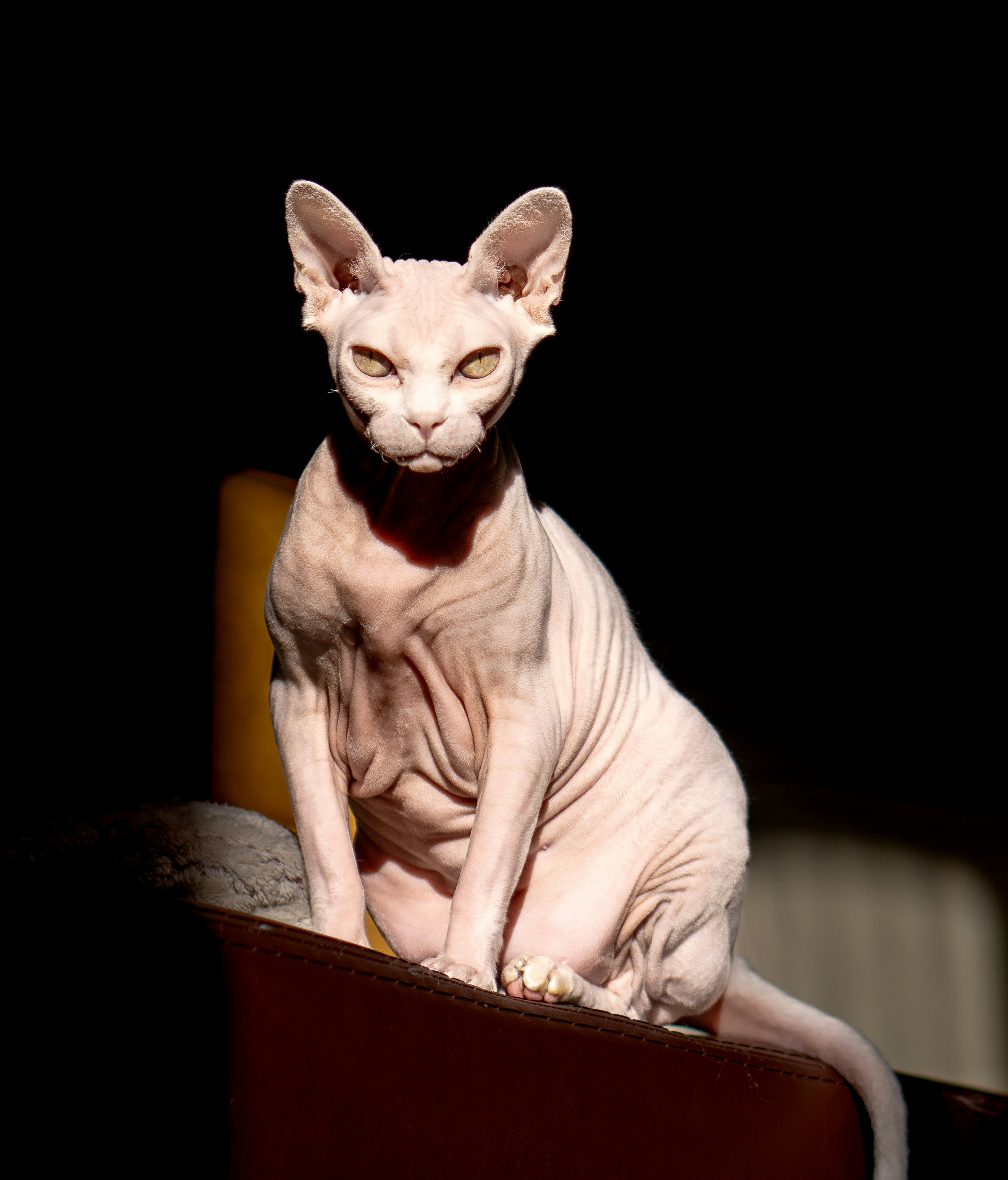
Physically, the Sphynx exhibits an elegant, medium-sized foreign somatotype. They carry a deceptively heavy, robust framework characterized by a hard, muscular body, a prominent rounded abdomen (often affectionately called a “potbelly”), and long, fine-boned limbs ending in unique paws with elongated digits. Their heads form a modified wedge shape with high cheekbones, prominent whisker pads, large lemon-shaped eyes, and enormous ears that flare out like natural satellite dishes.
The absolute hallmarks of the breed are its unique skin dynamics and thermal profiles:
- The Suede Down Phenotype: While a Sphynx looks completely naked from a distance, they are not truly hairless. Their entire body is covered in a microscopic, fine layer of short down hair. To the touch, their skin feels exactly like warm peach fuzz, a soft chamois cloth, or a heated velvet cushion.
- The Pigmented Skin Matrix: Because their skin contains the exact same genetic color pathways as standard fur, a Sphynx carries their coat pattern directly on their flesh. They are found in an infinite array of solid blacks, pristine whites, striking tortoiseshells, pointed shades, and classic tabby markings displayed beautifully on their skin.
- The Wrinkle Blueprint: A high-quality Sphynx must display heavy wrinkling around the muzzle, eyes, base of the ears, and across the shoulders. These wrinkles are highly prized in the show ring, emphasizing their unique elfin expressions. They also completely lack standard whiskers, possessing short, brittle stumps or zero vibrissae at all.
🧠 Behavior, Temperament, and Social Packs
The psychological and behavioural profile of the Sphynx centers around an extraordinarily high capacity for active human companionship, playful problem-solving, and constant social engagement.
1. The Living Hot-Water Bottle
Because they lack a thick coat of fur to trap their natural body heat, Sphynx cats possess a slightly higher core body temperature than standard felines. They act like little thermal radiators and are highly motivated by warmth seeking behaviour. A Sphynx will actively spend their day tracking sunny patches on the floor, perching on top of your internet router, or burrowing deep beneath your sweater sleeves and duvets to share your body heat.
2. Acrobatic Clowns and Elite Performers
Possessing an active, highly analytical mind, Sphynx cats require significant daily interaction to prevent boredom. Powered by a lean, athletic frame, they are exceptional high-jumpers that easily scale your curtains, doors, and highest shelving. They are natural performers that retain a frantic, joyous kitten-like play drive throughout their lives, easily mastering interactive puzzle toys, clicker tricks, and playing fetch with paper balls.
3. Extreme “Velcro” Pack Attachment
This breed completely rejects isolation and practices absolute, undivided attachment to their human families, earning them a reputation as ultimate “velcro cats.” If you work from home, they will wrap themselves over your shoulders like a living scarf or curl on your lap. Their stable, confident nervous system makes them highly gregarious; they do not hide from strangers, greeting household guests at the front door with zero hesitation.
🧼 Grooming, Diet, and Health Considerations
You might think a cat without fur requires zero grooming, but the opposite is true: the Sphynx is a high-maintenance breed that requires a dedicated hygiene routine.
1. Sebum and Oil Management
A standard cat’s fur naturally absorbs the protective oils (sebum) produced by the skin. Because the Sphynx lacks fur, these natural oils accumulate directly on the surface of their skin. If ignored, the oils can build up, leaving greasy marks on your light furniture and predisposing the cat to skin irritation or blackheads. A gentle, bi-monthly bath with a vet-approved, hypoallergenic baby shampoo is a mandatory care requirement.
2. Advanced Ear and Nail Care
Because they lack protective inner ear hairs, Sphynx ears produce a thick, dark wax to trap dust. Weekly ear cleanings with a soft cotton pad and a vet-approved flush are necessary. Furthermore, skin oils can gather beneath their nail sheaths, forming a dark crust. Cleaning their toe beans and clipping their nails monthly keeps their paws healthy and clean.
3. High-Metabolic Caloric Fueling
Sphynx cats possess an incredibly fast metabolism, burning calories rapidly to generate the body heat normally trapped by fur. They require a diet rich in high-quality animal proteins and healthy fats. Prioritizing a portion-controlled, nutrient-dense diet while avoiding free-feeding dry kibble is highly recommended to support their high metabolic needs.
4. Hypertrophic Cardiomyopathy (HCM)
Like many active pedigreed lines, the Sphynx can carry a hereditary risk for HCM, an inherited thickening of the heart walls. Modern responsible breeders utilize regular echocardiogram screenings on all active breeding stock to filter this condition out of their bloodlines.
Final Thoughts: Is the Sphynx Right for You?
Welcoming a Sphynx into your home is very much like introducing a permanent, high-speed bundle of pure, unconditional love into your family circle. If you travel constantly, leave your house empty for 12 hours a day, or prefer a low-maintenance, independent pet, their grooming needs and demand for physical proximity will quickly become overwhelming. But if you have the time to invest in weekly bathing routines, interactive puzzle games, and endless under-blanket cuddle loops, the Sphynx will reward you with matchless loyalty, endless entertainment, and an unforgettable bond. To read more about breed standards and official preservation lines, exploring the international registration logs on The International Cat Association (TICA) offers fantastic guidance for prospective owners.