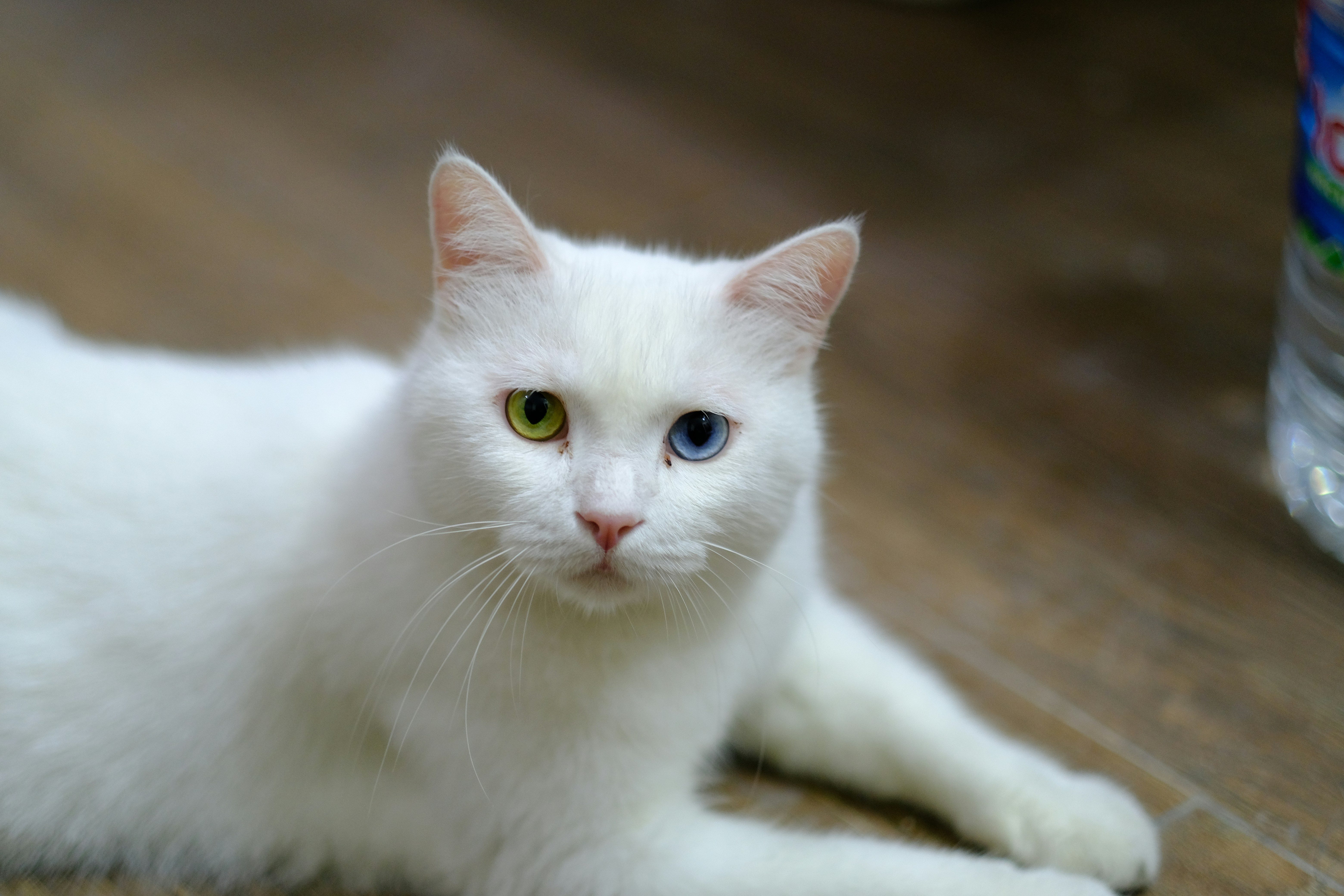


If your ideal feline companion is a quiet, independent lap ornament that blends passively into the background, the Khao Manee is definitively not the match for you. Universally celebrated as the “Diamond Eye” cat of Siam, this breathtaking breed is famous for its pure, snow-white coat and its extraordinarily bright, jewel-like eyes that frequently flash in completely different colors.
Often described as a living piece of ancient royal history wrapped in porcelain elegance, the Khao Manee lives life at full throttle. They are intensely human-oriented, exceptionally communicative, and highly active companions that treat their homes as vibrant territories to master. Let’s explore the rich history, specialized eye genetics, and dynamic behavioural profiles of the extraordinary Khao Manee cat.
🐾Physiological and Behavioral Profile
| Breed Attribute | Standard Metric / Trait |
|---|---|
| Average Weight | Males: 3.6kg – 5.0kg (8–11 lbs) Females: 2.7kg – 4.1kg (6–9 lbs) |
| Average Lifespan | 12 to 15 years |
| Coat Texture & Type | Short, exceptionally fine, smooth, and lying flat against the body; single-coated |
| Energy & Activity Level | Extremely High (Highly athletic, investigative, passionate about interactive games) |
| Vocalization Level | High (Exceedingly communicative; utilizes a wide range of vocal chirps and trills) |
From the Palaces of Siam: The Ancient, Hidden History
The history of the Khao Manee is deeply entwined with ancient Thai antiquity and royal prestige. Written historical records and beautiful illustrations found in the Tamra Maew (The Cat-Book Poems), which date back to the Ayutthaya Kingdom (1351–1767), refer to this striking breed as the Khao Plort, meaning “all white.” The name Khao Manee literally translates to “White Gem.”
For centuries, these felines were the strictly guarded secrets of the Thai royal family. Legend states that King Chulalongkorn (Rama V) was so deeply devoted to his Khao Manees that when British and French diplomats arrived in the 19th century to negotiate colonial boundaries, he actively hid his royal white cats, presenting his Siamese cats instead as the premier breed of the kingdom to protect the Khao Manee from being stolen or exported.
The breed’s introduction to the Western world occurred remarkably late, in 1999, when American environmentalist Colleen Freymuth imported the very first breeding pair from Thailand to the United States. The International Cat Association (TICA) officially granted the Khao Manee full championship status in 2015. Today, they remain exceptionally rare outside of Thailand, fiercely preserved by elite global registries.
📐 Distinct Physical Architecture & The Science of the Diamond Eyes
Physically, the Khao Manee exhibits an elegant, medium-sized foreign somatotype. They carry a lithe, muscular, and athletic framework characterized by long legs and a highly agile stance. Their heads form a modified wedge shape with high cheekbones, a straight profile, and large, upright ears that tilt slightly outward.
The absolute hallmarks of the breed are its pristine coat structure and its specialized ocular parameters:
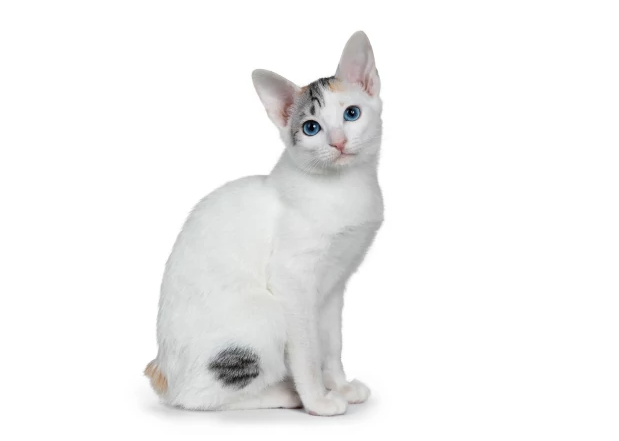
- The Dominant White Gene (W): The Khao Manee’s pure white coat is driven by a powerful dominant gene that masks all other underlying coat colors. Interestingly, Khao Manee kittens are occasionally born with a small dark smudge of color on their heads, which naturally disappears as their adult coat grows in. The fur is short, fine, and lacks a dense undercoat, giving it a satin-smooth feel.
- The Odd-Eyed Phenotype (Heterochromia): While Khao Manees can be born with two brilliant blue eyes or two yellow-gold eyes, the most highly prized and iconic look is Odd-Eyed. This occurs when one eye is a luminous sapphire blue and the other is a vibrant shade of amber, yellow, or sea-green. This striking contrast mimics the appearance of cut diamonds.
- The Luminescent Eye Rim: Their eyes possess a highly distinct, reflective border that naturally intensifies light, giving them an unusually bright, glowing quality even in standard daylight.
🧠 Behavior, Temperament, and Social Ecology
The psychological and behavioural profile of the Khao Manee centers around an extraordinarily high capacity for active human bonding, cognitive problem-solving, and vocal communication.
1. The Investigative Shadow
If you prefer an independent cat that blends seamlessly into the background, a Khao Manee will quickly disrupt your routine. This breed practices extreme, undivided attachment. They will shadow you into every room, perch directly on your shoulders while you type, and insist on helping you make the bed. They treat their human family as their personal pack and thrive on physical proximity.
2. Acrobatic Play and Retrieval
Possessing an active, highly analytical mind, Khao Manees require significant daily mental and physical stimulation. They are natural performers that retain a frantic, joyous kitten-like play drive well into adulthood. They easily master interactive puzzle toys, are highly receptive to clicker tricks, and are famous for their natural instinct to play fetch with paper balls or small plush mice.
3. The Royal Conversationalist
True to their Thai roots, Khao Manees are incredibly vocal. They do not use standard, harsh meows to communicate; instead, they possess a highly distinct, melodious vocal range capable of producing a wide array of trills, chirps, and vocal sweeps. They love to hold structured conversations with their owners, responding step-for-step when spoken to.
🧼 Grooming, Diet, and Health Considerations
Because their fine coat is short, tight, and completely lacks a fluffy undercoat, Khao Manees require almost no manual grooming. A quick weekly pass with a soft rubber brush or a grooming glove is more than enough to lift away loose guard hairs and keep their porcelain coat looking pristine. From a medical standpoint, they are a hardy, robust, and structurally sound breed, though their unique genetic structure requires focus in a few sectors:
- Congenital Deafness Link: In the wider feline world, the dominant white gene is occasionally linked to congenital deafness in the inner ear. However, because responsible Khao Manee lines are carefully managed and monitored via BAER (Brainstem Auditory Evoked Response) testing, modern pedigreed Khao Manees show a remarkably low incidence of hearing impairment compared to non-pedigreed white cats.
- Sun Exposure and Dermatological Safety: Because their ears and eyelids are covered in very fine, white fur over pale skin, they lack protective melanin. This makes them highly susceptible to sunburn and localized skin cancer if exposed to harsh, direct sunlight for prolonged periods. Keeping them strictly as indoor cats is a biological safety requirement.
- High-Activity Nutritional Balance: Because they maintain an exceptionally active lifestyle and burn energy quickly, they require a portion-controlled diet rich in high-quality animal proteins to support their lean muscle mass.
Final Thoughts: Is the Khao Manee Right for You?
Welcoming a Khao Manee into your home is very much like introducing a tiny, intensely loyal piece of living Thai history into your family circle. If you travel constantly, live in a highly cramped space without vertical boundaries, or prefer a quiet lap cat, their intense energy and demand for physical proximity will quickly become overwhelming. But if you have the time to invest in advanced clicker training, daily fetch sessions, and unconditional, shoulder-perching companionship, the Khao Manee will reward you with matchless loyalty, endless entertainment, and an unforgettable bond. To check out more about historical breed definitions, lineages, and registration lines, the comprehensive archives at the Governing Council of the Cat Fancy (GCCF) provide fantastic guidance for prospective owners.